
Uintah County Deed Records and Instrument Types
The Uintah County Recorder files real-estate documents and maintains cross-reference indexes and plats. A deed records a transfer or an estate conveyance. Mortgages, easements, liens, releases, and correction documents each touch a different part of the land record. The document type alone never proves title is clear. Read the legal description and the instrument text itself. Then hunt for later assignments, releases, corrections, or conveyances that shift the chain of title.
| Deed Type | What It Does | Common Use |
|---|---|---|
| Warranty deed | Conveys the grantor's stated interest with deed warranties | Ordinary transfer; read the exact covenants |
| Quitclaim deed | Transfers whatever interest the grantor may hold | Family, entity, or title clean-up transfer |
| Trustee or executor deed | Conveys land through an authorized fiduciary | Trust administration, probate, or foreclosure |
| Tax deed | Records a tax-related conveyance when legally issued | Verify sale and redemption facts with Treasurer |
| Correction deed | Fixes or clarifies a prior instrument | Compare both documents and their descriptions |
A mortgage or lien does not sell the parcel. It is a claim recorded against the land. Deeds transfer ownership; encumbrances limit it. Follow an original mortgage through assignments to its reconveyance or release, and follow a lien to a satisfaction, release, or court result. The Recorder's index shows what was filed, but enforceability and legal effect depend on the full document and later events.
Uintah Recorder Search Modes and Coverage
The county's LIDS notice puts complete electronic indexing from 1995 to the current date. That is the online coverage boundary. Name, address, serial or tax number, grantor, grantee, section-township-range, and filed survey searches are all described for subscribers. Plat searches are too. The public landing page shows access and coverage only. Result fields stay hidden until login. No date or book/page filter should be assumed beyond what that page displays.
| Search mode | Use in the deed trail | What is known |
|---|---|---|
| Name / party | Find an owner or entity by indexed name | Partial-match behavior is not displayed before login |
| Grantor | Find a party conveying an interest | Useful to move forward from a known seller |
| Grantee | Find a party receiving an interest | Useful to locate an acquisition deed |
| Serial / tax number | Join a deed search to a parcel | Also appears as an Assessor and GIS key |
| Section, township, range | Locate rural tracts by legal geography | Public landing page lists this search mode |
| Survey / plats | Find filed survey or recorded subdivision context | Final plats return to the County Recorder |
The Uintah County LIDS landing page shows the subscriber entry point and the coverage notice. It displays no authenticated result.
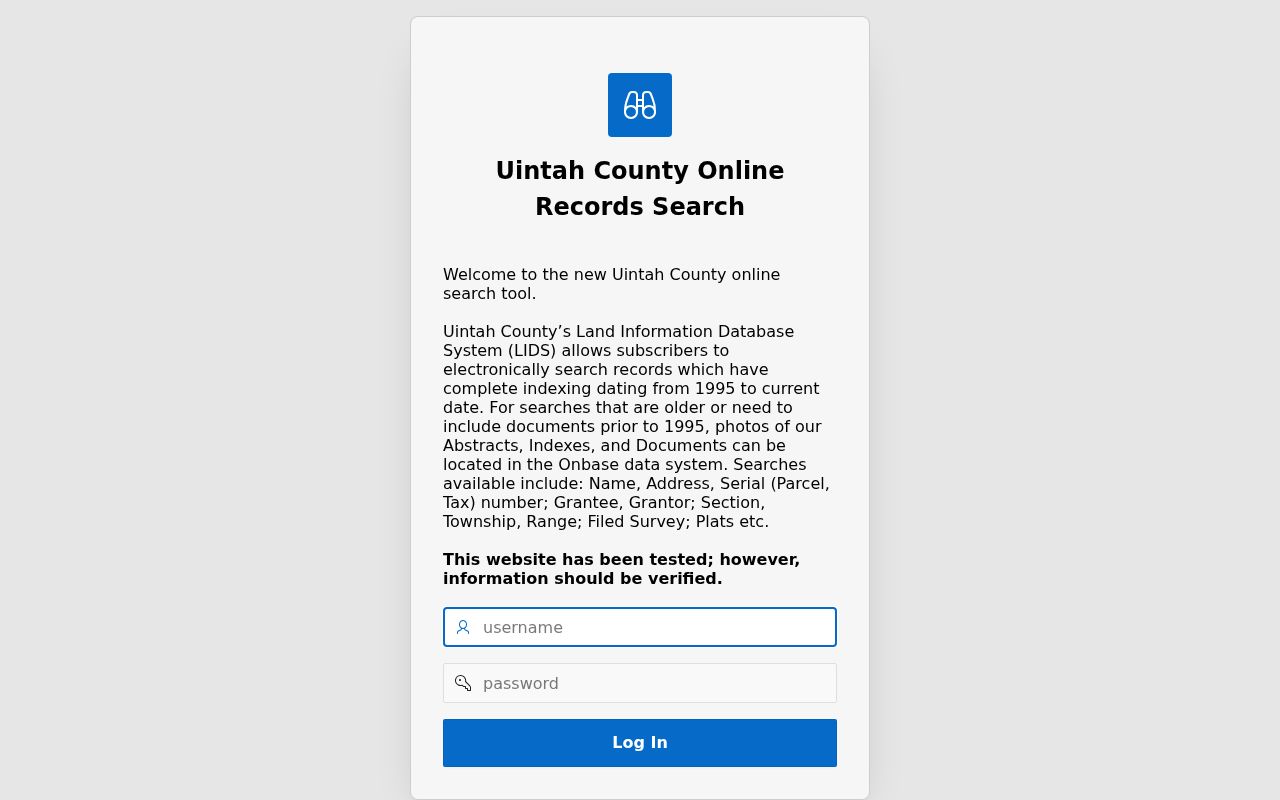
See where the index ends, then request the instrument.
Walk a Uintah County Grantor-Grantee Chain
A grantor gives an interest; a grantee receives one. Simple enough on paper. Yet names alone can mislead. The grantor-grantee index is read by party role, then checked against the parcel's serial number and legal description. A chain of title is the sequence of recorded transfers and related instruments for one tract. Start with the newest deed and work back through each prior grantee, because an owner-name search rarely holds the whole history.
- Use the Assessor to identify the parcel serial and current roll owner.
- Find the latest conveyance and confirm the parcel description, recording date, and parties.
- Search the grantee as a party on an earlier instrument, then match the legal description again.
- Repeat backward, noting quitclaims, estate deeds, tax deeds, plats, and correction documents.
- When the trail reaches the online cutoff, move to OnBase, books, microfilm, or historic images.
- Grantor
- The party identified as conveying an interest in an instrument.
- Grantee
- The party identified as receiving an interest.
- Chain of title
- The linked sequence of recorded transfers and related documents.
- Book and page
- A volume-and-page reference used in older records.
- Instrument number
- A recording identifier used to locate a filed document.
Older Uintah County Deed Records Need a New Search Route
The Recorder reports land records spanning 1894 to the present. Records since 1983 are computerized and microfilmed, while earlier material rests in books. LIDS runs complete from 1995 forward, and older abstracts, indexes, and documents are reachable through OnBase images. These are distinct layers of records, not one uniform database with a single search field.
FamilySearch's Uintah County Land and Property Records collection covers 1888-2004 and holds courthouse images of deeds, indexes, and mining claims. Catalog examples include a 1915 mining claim, 1945 warranty, quitclaim, and tax deeds, 1974 water-rights abstracts, and 1980 title abstracts. Mine those images for a party or instrument clue. Then verify against the county copy when the record matters for a current decision. Names may hide under initials, an estate, or an entity.
Need prior owners past the current index? The Uintah County former-owner trail explains how to switch systems at each historical cutoff.
The FamilySearch Uintah land collection describes its digitized courthouse records and historical instrument types, and the Uintah County courthouse access page is the source for the historic courthouse reference.
The courthouse stays the source named for the county's original land records. FamilySearch offers a separate image route.
Uintah County Recording Rules Shape a Deed Copy
Uintah County's recording rules shape every deed copy. The Recorder demands a legible original. It must carry printed or typed signer names, a notary acknowledgment, a caption naming its nature, a grantee mailing address, and a legal description. The formatting rules are just as specific. White 8.5-by-11-inch paper, one-inch left, right, and bottom margins, a reserved upper-right first-page space, one-sided black printing, and certified-copy legibility all apply. A document may be mailed with a check for the required fee.
Filing rules prove nothing more. A recorded document can still misdescribe a parcel, or a transfer can be legally ineffective. Compare every legal description with the recorded plat. A correction instrument amends a prior filing, and a later deed may convey only one lot of a larger tract. So keep both the original and corrected references.
Uintah Property Watch Flags New Recorded Instruments
Uintah County Recorder Property Watch sends owners free alerts. Signup needs only a name and an email. The subscriber must already appear as an owner on the parcel. Notices attach to parcel numbers. They cover deeds, liens, and reconveyance deeds. One address may hold several parcels, so submit each one, because the alert keys to a single parcel number.
Treat each notice as a cue to read the filed document itself. An unexpected alert deserves a quick call. Pull the recording reference and contact the Recorder through its official page. The County treats subscriber contact details as private. Property Watch is no substitute for a title search, and it will not flag every possible legal claim. The Property Watch signup shows the owner and parcel requirements in full.
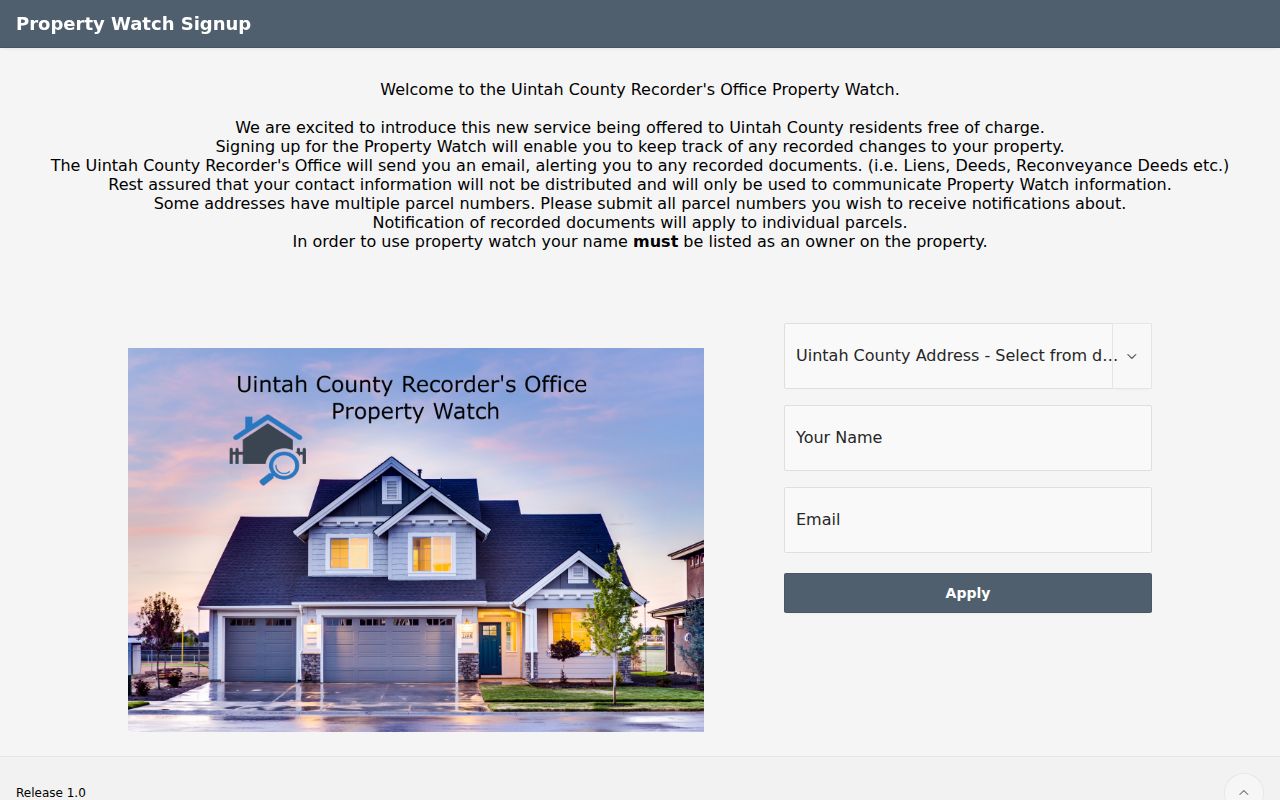
Owners can watch for recorded changes, then check the Recorder's document itself.
Grantor and Grantee Names in Uintah County Deeds
The Recorder's party index reflects the roles named in the deed itself. A grantor conveys the interest. A grantee receives it. When the direction of a transfer is unclear, search both sides. Add a middle initial or entity suffix when known. One deed can name several grantors, trustees, representatives, or grantees. A single-name search may therefore miss the document. The indexed party proves a recorded instrument. It does not prove that the person lives at the property now.
To tie an index entry to land, compare the parcel serial and the legal description. A deed may cover several parcels or part of one. Tax parcels can also be split or combined after recording. Treat the Assessor's current parcel number as a cross-reference. Do not treat it as a replacement for reading the instrument. For conveyances older than the digital search, use the book and page reference to request the image. You can also check the earlier system.
Request a Uintah County Deed Copy
You can inspect records at the Recorder's office and buy copies there. Online perusal takes an agreement or subscription. The public LIDS notice posts no full copy-fee schedule. The 2026 Recorder page says HB-38 raised recording fees by five dollars effective May 6, 2026. That change hits filings, not copy prices. Check the county's current fee schedule or call before sending payment.
For a copy request, give the parcel serial, the names, an approximate recording date, and any instrument or book and page reference. Ask about uncertified, certified, or electronic copies. Ask the current charge too. The county's mail-recording instruction covers submitting documents, not proof that copy requests are filled by mail. Call first for a particular format. Call for an older image too. Recorder staff can start a historical search with you, but they will not run a full search on your behalf.
Recorded, not guaranteed. Uintah County deed records show documents accepted for recording, but an index is not a title opinion and may not reveal an unrecorded interest. Confirm title through a qualified title search.