
Find Who Owns Uintah County Property by Record Trail
Chase the parcel, not the person living there. Start with the Assessor's parcel search in Uintah County. Copy the serial number and the current owner field. Then take that name and serial into the Recorder's index and pull the newest recorded deed. The two offices work on different clocks: the Assessor refreshes the tax roll once a year, while a deed lands in the Recorder's index once it is recorded and processed. A closing that lands near the roll update can leave yesterday's name on the tax card for a while.
- Find the subject parcel in Uintah County Property Search and copy its complete serial.
- Read the Assessor's owner field and keep the mailing and situs addresses separate.
- Search the Recorder's latest conveyance by parcel and party, then compare the grantee and legal description.
- If the grantee is an entity, check Utah's business registry for entity status and agent details.
- For a past owner or an older instrument, follow the Recorder's index and historical-image routes.
Sources for a Uintah County Property Owner Name
Several Uintah County records can carry an ownership name, but the fields do different jobs. The Assessor names the tax-roll owner. The Recorder indexes grantees and parties to recorded instruments. GIS maps add an OWNER attribute per parcel. That string can lag behind or run simplified. The grantee is sometimes an LLC. Utah's entity registry then adds filing status and a registered agent. Compare the record date and the parcel description before calling two names a match.
| Source | Owner Info It Gives | Access |
|---|---|---|
| Assessor roll | Tax-roll owner and parcel details | Public Property Search; office or GRAMA for other records |
| Recorder index | Grantor, grantee, and recorded instrument references | LIDS subscriber access; OnBase or office for older items |
| GIS parcel layer | OWNER field and parcel serial in map data | County map and public ArcGIS services |
| Utah entity search | Entity status and registered-agent information where filed | State business registry; not proof of parcel ownership |
The owner of record is a name on paper. Nothing about that field proves who lives there. A tax mailing address can point to an owner, a lender, an agent, or a post-office box. GIS owner strings can lag or simplify. For the recorded conveyance itself, the deed and its legal description are the evidence.
Uintah County Owner Records Can Lag a Closing
The Assessor updates value data annually, with real property valued as of January 1. The Recorder indexes a deed as the instrument is accepted and processed. That timing means a sale after the assessment date, a recently submitted deed, or an indexing delay can create a short period when the tax roll and newest deed show different names. Keep the date on each record and do not resolve the mismatch by choosing whichever page loads first.
For a recent purchase, search the Recorder for the latest conveyance and match its serial or legal description. The Assessor remains useful for the annual owner-of-record field, value, and property characteristics. If the deed appears in the index but the roll has not changed, ask the Assessor about its update schedule rather than assuming the deed has been rejected. A current-owner question deserves a date-stamped answer.
The Uintah County Property Search shows parcel, owner, and address search fields, but the research did not capture a live sample owner card.
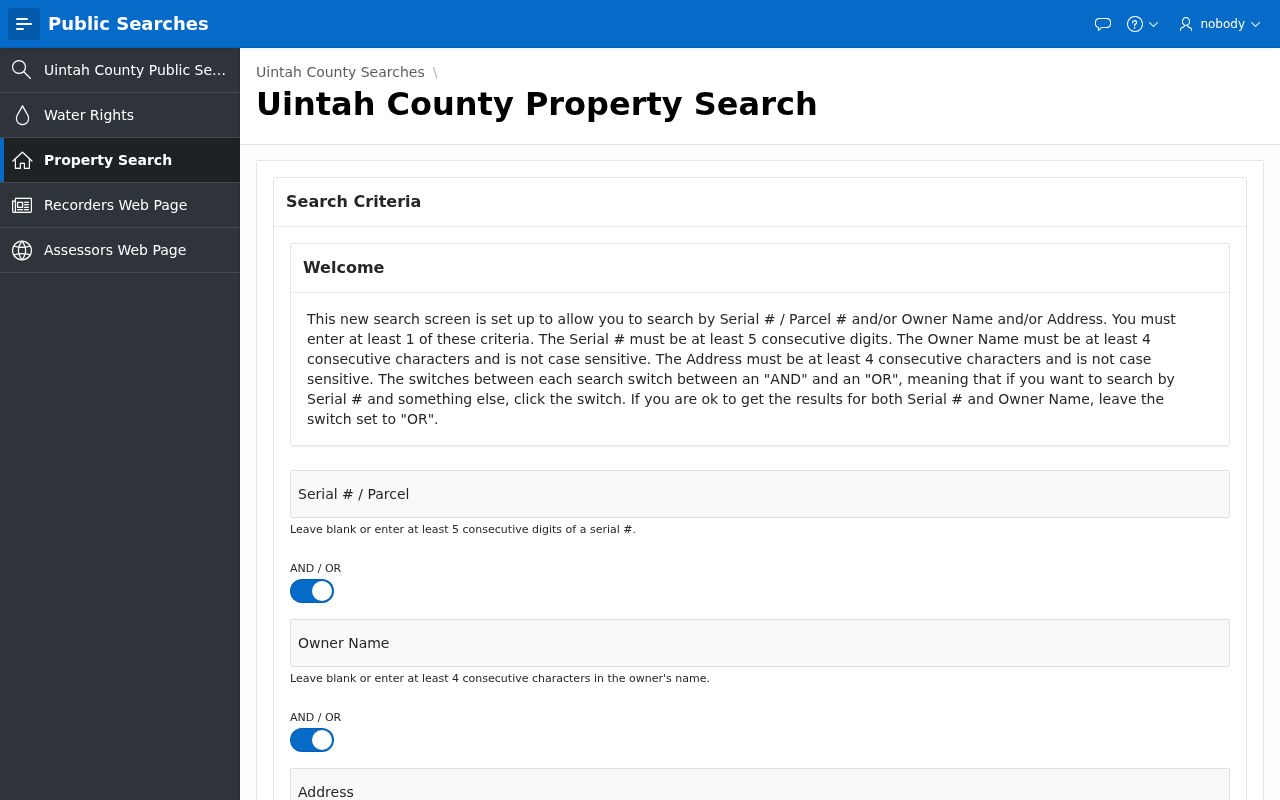
The search form is where the lookup begins. Owner and mailing fields that come back should be confirmed for the parcel itself.
When a Uintah Property Owner Is an LLC or Trust
Uintah County deeds often name entities, not individuals. Corporations, LLCs, partnerships, trusts, estates, and homeowners associations all appear on the tax roll. Search the exact entity string first. Try the Assessor, then the Recorder. Utah's Division of Corporations and Commercial Code adds entity status, a registered agent, office address, prior names, and filings where available. A registered agent receives legal notices for the entity. The agent is not necessarily the owner, occupant, or manager of the parcel.
Ballard Springs shows why entity names need parcel context. The Phase 1 Amended plat names Ballard Springs Townhomes, LLC and separates individual lots from HOA common and limited-common parcels. A name search can return the association's land alongside separate townhome parcels. Match each result to its plat and serial number. The entity is not automatically owner of every polygon in the subdivision.
Utah's business search runs through the Division of Corporations and Commercial Code. Filing records identify the entity. The deed establishes the land-record connection.
Uintah County Property Watch Is an Owner Alert
The Recorder runs a free Property Watch email service. It flags recorded deeds, liens, and reconveyance deeds. The subscriber's own name must appear as an owner. Alerts attach to parcel numbers, so one address covering several serials needs each one added. That makes the tool useful right after an ownership search, since an owner can watch for later instruments tied to the parcel.
Property Watch has limits. It cannot replace the Recorder's index, does not certify a deed, and will not stop a filing. Check any unexpected notice against the official instrument. The County says contact information is not distributed through the program, and the service is not a way to learn who occupies a property or to track another person's activity without authorization.
Confirm a Uintah County Owner Across Records
Start with the parcel serial. Match the Assessor's owner of record against the newest deed the Recorder has indexed. The two systems answer different questions. The Assessor's tax roll serves valuation, while a recorded deed shows a transfer the Recorder accepted. Updates arrive on separate schedules, so a name can change in one system first. A deed can also affect only part of a parcel or describe land later divided, so compare recording and assessment dates before calling a mismatch an error.
Entity owners deserve extra care. Copy the exact name from the public record, whether the owner is a company, trust, or estate. Search the Recorder's grantor and grantee fields with spelling variations, initials, punctuation, and common suffixes. The Utah Division of Corporations can verify a business filing, but its officers and registered agent are not automatically the beneficial owners of land. A trustee may sign for a trust. Signing does not create personal ownership.
Keep an evidence note. List each source, the parcel serial, the document date, and what each record actually says. For a purchase, inheritance, dispute, or lien question, have a qualified title professional or attorney review the documents. A lookup cannot settle validity, easements, or unrecorded claims. Respect Utah's Safe at Home program. Do not try to reconstruct a protected residence.
- Find the parcel in the Assessor's Property Search and record the serial and displayed owner.
- Search the Recorder index for the latest relevant grantee and grantor entries.
- Compare the instrument's legal description with the current parcel before treating the names as a match.
Check the Dates Behind a Uintah County Owner Name
Owner names do not flip instantly. Recording, parcel maintenance, and the next assessment roll each run on their own schedule. No lookup guarantees a fresh name on every screen right after closing. A recent buyer may be missing from an online Assessor result. Search the Recorder by grantee name and recording date instead. Check that the deed is indexed. Check the parcel description too. An older tax-roll name alone never means the conveyance failed.
The reverse holds as well. A current Assessor name proves nothing about completeness. Deeds, liens, judgments, and private agreements may all sit outside what one search returns. The County's Property Watch service can notify a registered owner about selected deeds, liens, and reconveyances. These notices are tied to a parcel serial. It is an alert service, not a title examination. Purchase or inheritance questions may need a professional search across recorded documents and court records.
Tax-bill delivery problems have their own fix. Update the mailing details through the Assessor or Treasurer as the County directs. A mailing address only routes County correspondence, not a verified home. Keep the question focused on the parcel. Avoid contacting unrelated people who appear in search results.
Limits of a Uintah County Owner Lookup
A public owner record only names the party the Assessor lists or the party a recorded deed names. It does not show who lives there. It cannot confirm clear title. A private, unrecorded interest can stay invisible to any search. A corporation's agent is not necessarily its beneficial owner, and an estate may use a personal representative's name. Utah's Safe at Home program gives qualified participants a substitute address, so those protected addresses should never be reconstructed through other records.
Lawful use. Use Uintah County owner information for property research, purchase diligence, and civic purposes. Never use public records to stalk, harass, target, or harm a person.